- The Inner Power
- Posts
- Why Won't My Team Take Ownership?
Why Won't My Team Take Ownership?
Because you fix every decision they make and they've learned to let you

Anil Karakkattuu
February 19, 2026
My team isn't taking ownership.
Heard this three times last week.
I asked one founder: "What happens when they make a decision without you?"
His answer: "I usually have to fix it."
But what I actually heard: "I don't trust them to get it right."
So I pushed: "How often do you fix it?"
"Maybe 70% of the time."
There's your problem.
It's not that your team won't take ownership.
It's that you won't let them fail.
The Pattern Nobody Sees
You hired smart people.
Then you don't trust them to make decisions.
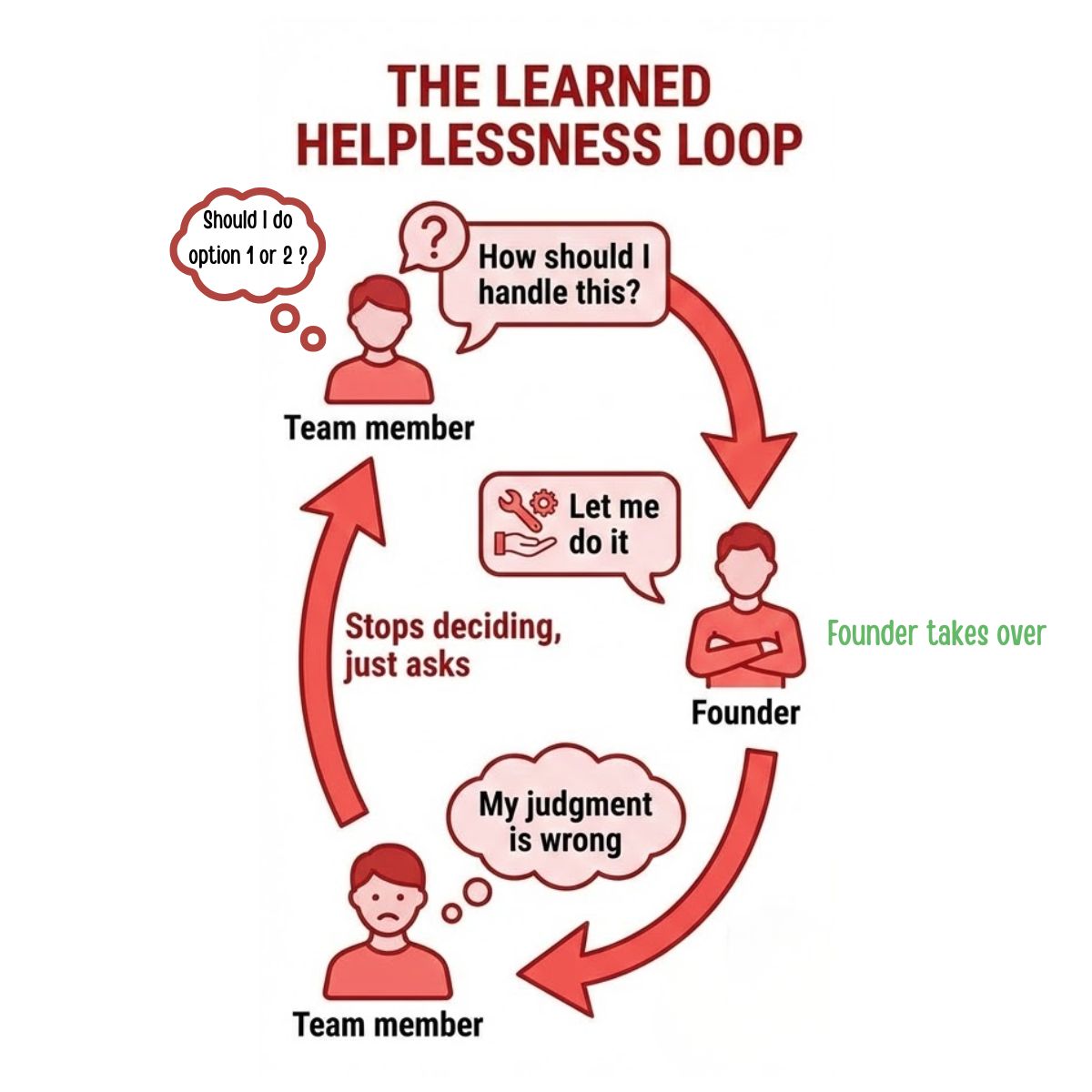
So your team learns: Don't decide. Just ask.
Then you get frustrated: "Why won't they take ownership?"
Because you taught them not to.
Every time you fix their decision, you're teaching them their judgment isn't good enough.
Eventually, they stop using it.
What "Fixing Everything" Actually Does
You think you're protecting quality.
Maintaining standards. Catching mistakes before they become problems.
But what you're actually doing is preventing growth.
Here's what happens:
Your team brings you a decision. You tweak it.
They bring you another. You change it.
After a few rounds, they stop bringing you decisions. They bring you questions.
"What should I do about X?" becomes the default.
And you wonder why nothing moves without you.
The Real Cost of Your Corrections
This isn't just about ownership.
It's about what your constant corrections are teaching your company.
When you fix every decision, you're saying:
"Your judgment isn't trustworthy." So they stop trusting it.
"There's only one right answer." So they stop thinking creatively.
"Mistakes are unacceptable." So they stop taking risks.
And risk-taking is how companies grow.
Your best people? They leave.
Because they didn't sign up to be order-takers. They signed up to build something.
The Mistake Most Founders Make
You think the problem is capability.
"They just don't have the experience yet."
"They need more coaching."
"I need to hire more senior people."
No.
The root cause isn't capability. It's learned helplessness.
Years of being corrected taught them their decisions don't matter.
So they stopped making them.
Here's The Rule That Changes Everything
I follow a simple rule:
First mistake = learning opportunity.
You let it stand. Even if you'd do it differently.
Because doing it differently isn't wrong.
Second mistake on the same thing = coaching issue.
Now you step in. But you coach, you don't fix.
Third mistake = competency issue.
Either they're in the wrong role, or you are.
But that FIRST mistake?
You let it play out.
The One Change That Fixed This
I told that founder to change one thing:
Only intervene if the mistake impacts customers or revenue.
Everything else? Let it play out.
Here's what happened:
His VP made a hiring decision he disagreed with. He stayed quiet.
Three months later, the hire was crushing it. Different style than he would've picked. But effective.
His product lead chose a feature prioritization he wouldn't have chosen. He let it run.
Two months later, the data proved it was the right call.
Not every decision went well. Some failed.
But his team started moving faster. Making bolder calls. Taking ownership.
Because they finally learned their judgment mattered.
What You're Actually Protecting
When you catch every mistake before it becomes visible, you think you're protecting quality.
You're not.
You're protecting your ego.
The belief that you know better. That you see things they don't. That the company needs you to catch everything.
Maybe that was true at $1M.
It's not true at $5M and above.
At scale, your corrections don't protect quality. They kill velocity.
The Question That Changes Everything
Next time someone brings you a decision, ask yourself:
"Will this decision materially harm the business?"
Not "Would I do it differently?"
Not "Is this the optimal choice?"
Will it actually harm the business?
If the answer is no, let it stand.
Even if you disagree.
Even if you could improve it.
Even if it makes you uncomfortable.
Because the cost of letting them learn is less than the cost of teaching them not to think.
What Fast-Growing Companies Do Differently
The companies that scale don't have fewer mistakes.
They have better systems for who decides what.
Here's what they understand:
Most decisions are reversible. If it goes wrong, you fix it then. Not before.
Different approaches can work. Your way isn't the only way.
Ownership requires risk. If they can't fail, they can't own it.
The founders who scale aren't smarter.
They've just learned to let go of decisions that don't need them.
Where Most Founders Get Stuck
They know they need to delegate.
But they don't know:
Which decisions they actually need to catch vs. let play out
How to tell the difference between a learning mistake and a competency issue
How to give feedback without taking the decision back
Why their "helpful corrections" are killing ownership
So they keep fixing everything.
And wondering why their team won't step up.
One Thing You Can Do Today
Pick one person on your team.
For the next two weeks, only intervene on their decisions if it will materially harm customers or revenue.
Everything else? Bite your tongue.
Watch what happens.
You'll probably see some decisions you disagree with.
You might see one or two actual mistakes.
But you'll also see something else:
They'll start moving faster.
Making bolder calls. Coming to you with solutions instead of questions.
Taking ownership.
Because you finally gave them permission to use their judgment.
What Changes When You Fix This
Your team starts making decisions.
They don't wait on you anymore.
Your best people stay.
They're finally doing the job they were hired for.
Execution speeds up.
Bottlenecks disappear when decisions don't need your approval.
Your company becomes more valuable.
Because it doesn't depend entirely on you.
And you get your time back.
To work on decisions only you can make.
The Bottom Line
If your team isn't taking ownership, look in the mirror.
You probably trained them not to.
Every correction taught them their judgment doesn't matter.
Every fix taught them to ask instead of decide.
Every intervention taught them you don't trust them.
And now you're frustrated they won't step up.
The fix isn't hiring better people.
It's letting the people you have actually decide.
Stop protecting them from mistakes.
Start protecting their ability to learn from them.
Because ownership isn't given. It's earned.
And they can't earn it if you never let them try.
If your team can't make mistakes, they can't make decisions.
Here’s how I can help you.
I help growth-stage founders cut decision chaos, drive efficiency, and grow profitably without burning out.
If you're exhausted from constant decision-making and barely have mental energy left for the choices that actually grow your business, I can help.
Book a free 45 minute clarity call. A focused, no fluff conversation to help you:
Pinpoint the real challenge behind the chaos
Get clear on what matters most right now
Walk away with one next move you can act on immediately
Thanks for reading this edition of The Inner Power.
This isn't motivational fluff.
This is the mental framework that separates founders who scale from those who burn out making the same mistakes over and over.
Your business strategy is only as good as your ability to think clearly under pressure.
Every decision you eliminate frees up mental energy for the choices that actually build wealth.
So stop drowning in daily decisions. Start building systems that think for you. And create the business that runs profitably without running you into the ground.
If this sparked something for you, pass it on to a founder who needs it too.
Thank you once again for being a part of The Inner Power community!
Reply